Published 4 June 2026 · Last updated September 2026
A verified action is a predefined customer behaviour that is checked before it’s recorded as complete: a passed quiz, a completed referral, a product step, a poll response, an event check-in. Impressions and clicks measure exposure. Verified actions measure what the customer completed, and cost per verified action puts a price on it that sits next to CPC and CPA on a media plan.
Marketing has become good at counting. You can report impressions, views, clicks, likes and sessions for any campaign within minutes of it going live, and each of those numbers is accurate. The trouble is what they count. Activity and outcome are different things, and a verified-action model asks the question exposure metrics can’t: what did the customer complete?
What is a verified action?
A verified action is a customer behaviour you defined in advance and confirmed after the fact. The confirmation method depends on the action. A tracked link confirms a visit. A correct answer confirms comprehension. A referral counts when the referred person completes their own step. A product event confirms an onboarding milestone. A scan confirms attendance.
The two conditions matter equally. “Defined in advance” means you decided what counts before the campaign ran, so the number can’t be reinterpreted afterwards. “Confirmed” means the campaign checked it, so an attempt and a completion are recorded as different things.
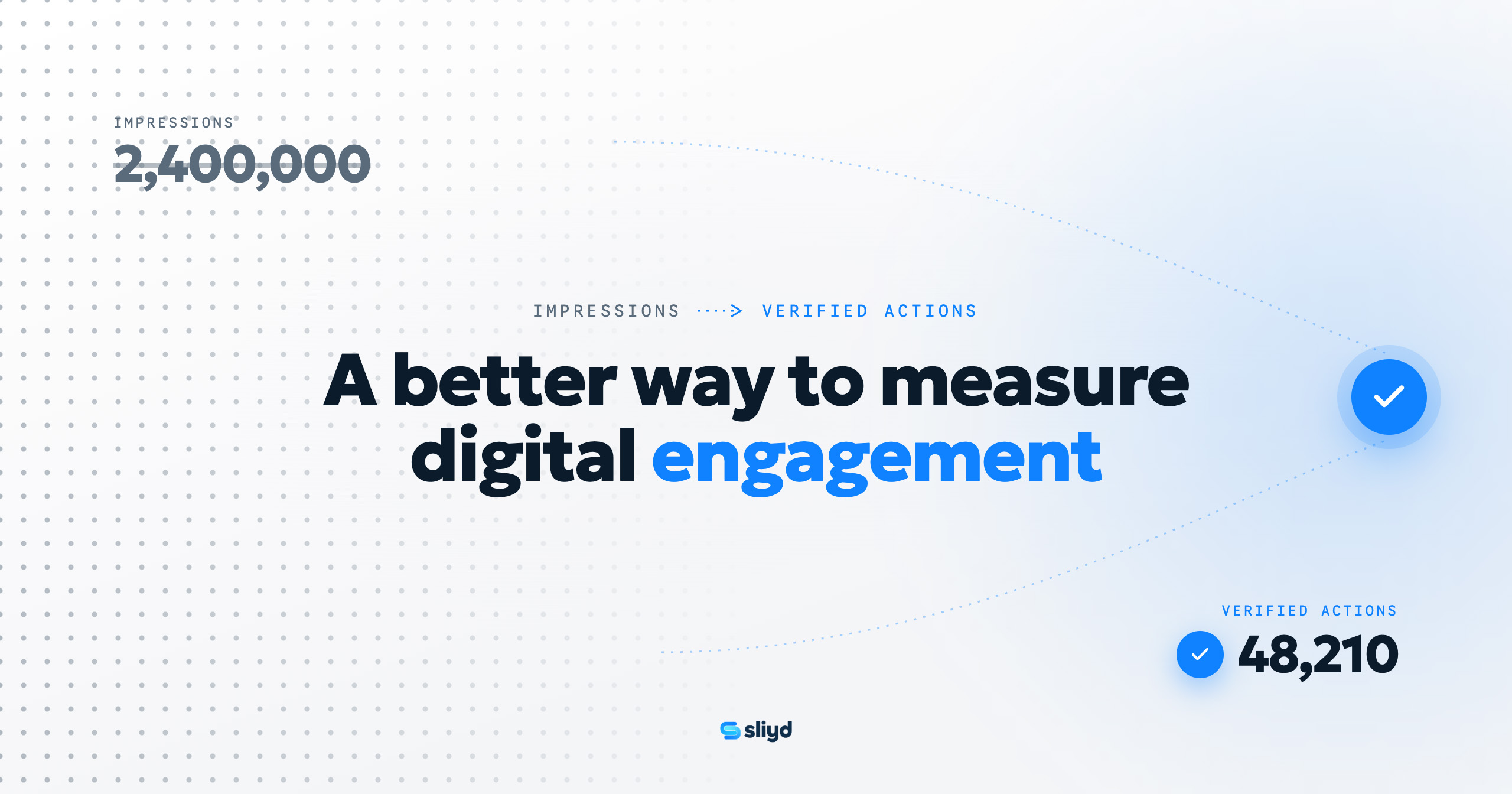
Put the two reports side by side and the difference is plain. The exposure report for a launch says 400,000 impressions, 12,000 clicks and a 3% click-through rate. The verified-action report for the same launch says 9,000 people watched the explainer to the end, 6,400 answered the question and 5,100 got it right, at £0.55 per verified answer. (Illustrative figures.) The first report tells you the media ran. The second tells you what the audience now knows.
What is the difference between an impression and a verified action?
An impression tells you an advert was displayed. A verified action tells you a participant completed something you asked for. Neither replaces the other. Impressions remain the right measure of reach, and verified actions are the right measure when the campaign exists to produce a behaviour.
| Traditional metric | What it proves | Verified-action equivalent | What it proves |
|---|---|---|---|
| Impression | An advert was displayed | Verified view or completion | The content was watched to the end |
| Click | A link was touched | Verified visit or action | The page loaded and the action was completed |
| Engagement | Something happened on a platform | Verified social action | A real person completed a defined step |
| Video view | A video started | Qualified video completion | The viewer watched and answered a question |
| Lead | A form was submitted | Verified participant | A person completed the qualifying action |
| CPC / CPE | Cost per touch | Cost per verified action | Cost per completed behaviour |
Each row on the right is a narrower version of the row on the left. The narrowing is the point: a smaller number that describes an outcome is more useful than a larger number that describes an event.
Click versus verified visit. A click is an interaction with a link. It doesn’t tell you the page loaded, the person stayed, or anything else happened. Once the objective goes beyond traffic, the measurement should go beyond the click.
Video view versus qualified view. A view records exposure. A video followed by a comprehension question records whether the viewer could show a basic understanding of what they watched. Watch, Learn & Earn is built on that distinction.
Engagement versus verified social action. “Engagement” is a useful umbrella and a vague one, because it covers behaviours with different levels of intent. Define the behaviour you value, then measure it on its own. Rewarded social media marketing shows what that looks like when the campaign starts on a social post.
Why does cost per verified action matter?
Performance marketers need a number that can sit next to the other channels on the plan. Cost per verified action is that number for a behaviour-led campaign.
Campaign spend ÷ verified actions = cost per verified actionHow Sliyd reports it. Sliyd uses cost per verified action to connect campaign spend with completed behaviour. Reporting separates verified from rejected activity, budget draws down only as actions pass verification, and each verified action is attributed to the participant’s digital wallet.
A campaign reported at £0.43 per verified action (an illustration rather than a benchmark) can be compared with paid search, paid social and affiliate on the same slide, and that comparison is what decides whether the channel is funded again. The guide on how to measure a digital rewards campaign works through the full metric set.
Does every campaign need verification?
No. Verification adds a step, and a step should earn its place. The rule is to measure what the objective is. If the goal is reach, measure reach. If the goal is traffic, measure traffic. If the goal is a completed customer behaviour, measure the completed behaviour, and don’t accept a proxy for it.
The failure mode is treating every interaction as equal. A one-second accidental click and a completed product journey both register as engagement in a dashboard that doesn’t distinguish them, and a budget allocated on that dashboard will keep buying the click. Measurement that reflects the objective fixes the allocation, because the cheap interactions stop counting.
How do you move a campaign from exposure to verified actions?
Decide the action before you decide the creative. Name the one behaviour the campaign exists to produce, in terms a system can check. Choose the verification method that fits it. Attach a reward that makes the exchange fair. Report spend, verified actions, cost per verified action, rejected activity and what participants did next, in that order.
Objective → Defined action → Verification method → Reward → ReportThis is the working model behind rewarded action marketing: campaigns funded against completed, verified actions rather than against impressions or ambiguous engagement. It doesn’t retire the exposure metrics. It puts a second column beside them that answers the question the first column was never designed for.