Published 13 January 2026 · Last updated September 2026
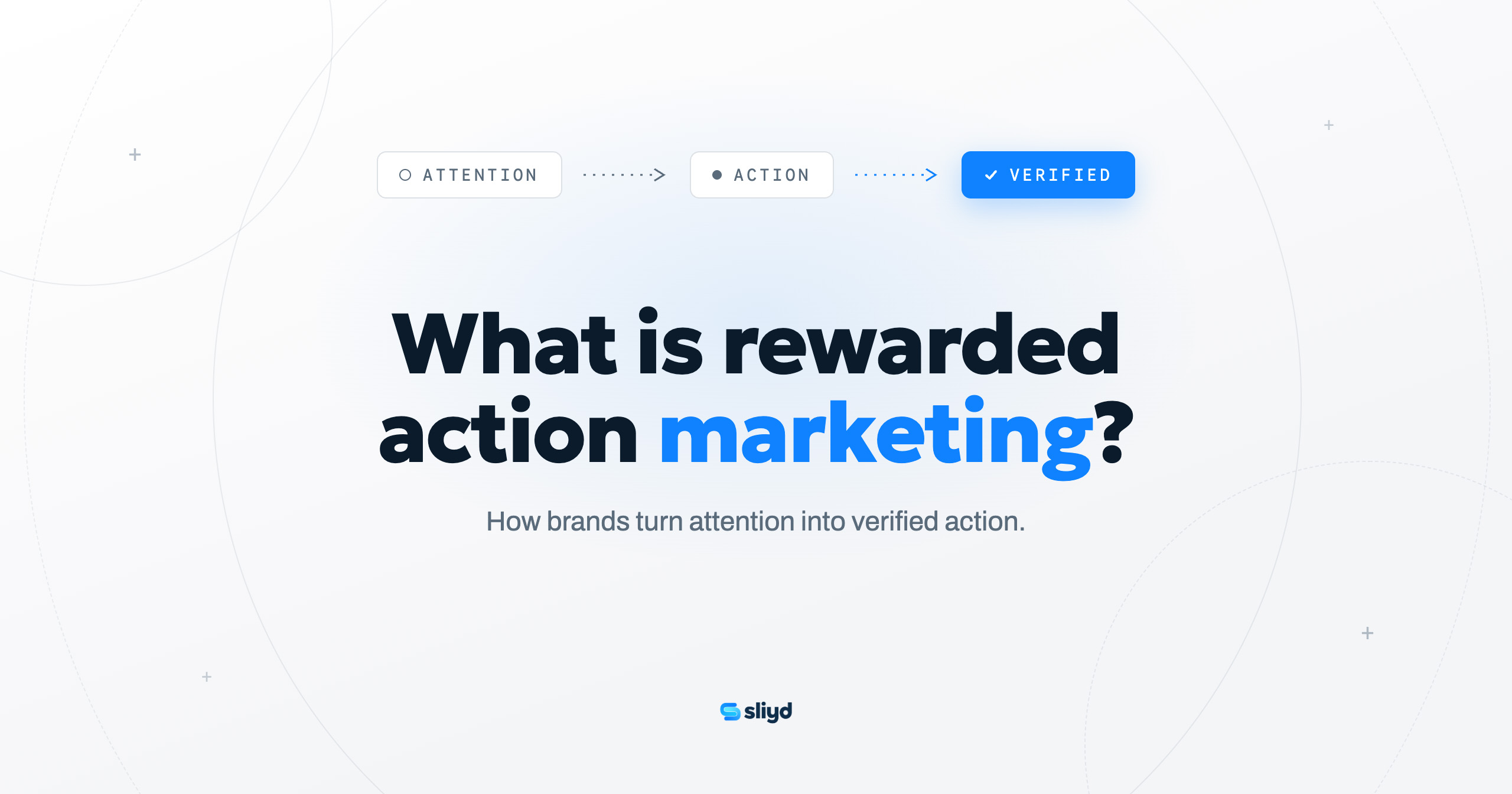
Let’s get straight into business: Rewarded action marketing is a value exchange with a confirmation in the middle. A brand asks a consumer to complete a specific, measurable action, confirms that the action has happened, and then gives that consumer a reward. The marketing budget pays for completed actions that directly benefit the brand rather than for exposure; Every part of the budget maps onto behaviour brands can count.
Brands have spent years paying for attention. Impressions, reach, views and clicks are all indicators that an advert was shown or a link was touched, but none of these are confirmation that the consumer completed the action that you built the campaign for. Rewarded action marketing introduces an incentive to move the consumer across the gap. You name the action, the customer completes it, the campaign checks it, and the reward follows.
How does rewarded action marketing work?
A rewarded campaign has four parts, and the order matters.
Define the action. Decide what you want a person to do, in terms a system can check. “Engage with the brand” fails that test. “Watch the 40-second explainer and answer one question about it” passes. The closer the action sits to a real marketing objective, the more the campaign is worth to you.
Share the link. The campaign travels as a single link or QR code. You put it in a social post, an email, a landing page or on a poster at an event, and the customer opens it on their phone. With one-click onboarding there’s no app to install and no account to create, so the campaign stays in the foreground and the plumbing stays out of sight.
Verify what happened. This step separates a rewarded action from a giveaway. Before releasing the reward, the campaign confirms that the action took place: the quiz answer was correct, the referred friend completed their own step, the product event fired. A tap on a button proves nothing on its own.
Deliver the reward at once. Someone who completes an action and then waits three days, fills in another form or installs an app to collect has stopped feeling the exchange. The reward should land while the interaction is still happening, in a digital wallet the customer opened by clicking the link.
Define → Share → Verify → Reward → AttributeAttribution is the fifth step and the reason the model exists. Every verified action carries an identifier, so you can see who completed it, through which channel, and what they did afterwards.
What actions can a brand reward?
Any action a customer can complete and a system can confirm qualifies. Social posts are the obvious starting point, and they’re the smallest part of the picture.
| Action | What it tells you | How it is verified | Metric to report |
|---|---|---|---|
| Visit a product page | Interest | Tracked link opened | Verified visits |
| Watch a video and answer a question | Understanding | Correct answer | Quiz pass rate |
| Answer a short poll | Declared preference | Completed response | Cost per response |
| Refer a friend | Advocacy | The referred person completes their own action | Qualified referrals |
| Complete an onboarding step | Activation | Product event recorded | Activation rate |
| Scan a code at an event | Participation | On-site QR scan | Verified attendance |
Sliyd runs rewarded actions across social and first-party channels, including link visits, referrals, quizzes, polls, newsletter sign-ups, app installs, product usage and events. A single customer might be rewarded for discovering a product this month, learning how it works next month and referring a colleague after that, with each step attributed to the same person. Watch, Learn & Earn covers the education format in detail, and rewarded social media marketing covers the social entry point.
How is a rewarded action verified?
Verification depends on the action. A tracked link confirms a visit. A correct answer confirms a quiz. A referral counts when the referred person completes their own action. The platform’s own record confirms a social action, and the customer’s claim on its own confirms nothing.
Sliyd platform data, January 2026. Sliyd reward campaigns have created more than 200,000 digital wallets. Sliyd verifies each action before releasing the reward, reports verified and rejected actions as two figures, and rejected actions do not draw down the campaign budget.
That last point changes the economics. In a conventional giveaway you pay for every claim, including the ones from people who never did the thing. In a verified campaign the failed attempts cost you nothing, and the report shows you how many there were.
How should you measure rewarded action marketing?
Measure the action. The reward is the incentive, and the verified action is the outcome you paid for. “We gave away 20,000 rewards” describes your spending. “We produced 14,200 verified actions at £0.43 each, and 8% of participants went on to the next step” describes a result. Those numbers are an illustration, and they show the shape of a useful report.
Depending on the campaign, the metrics worth tracking are cost per verified action, completion rate, verification rate, quiz pass rate, referral rate, conversion after the reward and repeat participation. Each one connects spend to a behaviour, which is what lets a rewarded campaign sit next to paid search and paid social in a media plan. The guide to how to measure a digital rewards campaign covers each metric and how to report it.
Why does this model suit brands now?
Digital marketing is excellent at measuring exposure and weak at proving what happened afterwards. Attribution has become harder as customer journeys spread across devices and sessions, and the gap between “we reached them” and “they did something” is where budgets get questioned.
Rewarded action marketing closes that gap by design. You pay for a verified action, the customer receives something of value, and both sides can see the exchange. That is the model behind Sliyd: pay for the verified action, and treat attention as the means rather than the end.
Ready to turn a campaign goal into a rewarded action? Talk to Sliyd about digital rewards for brands.
Related reading: the 100,000-wallet reward campaign that Sliyd discussed in January 2026.
FAQS
Rewarded action marketing is a model where a brand offers a digital reward for completing a specific action and verifies that the action happened before releasing the reward. The brand pays for completed behaviour rather than for exposure.
Page visits, video views followed by a comprehension question, polls, referrals, newsletter sign-ups, app installs, product milestones and event attendance. The action should be one a system can confirm.
The method depends on the action: tracked links for visits, correct answers for quizzes, completion by the referred person for referrals, product events for onboarding steps, QR scans for events and the platform’s own record for social actions. Sliyd verifies before releasing the reward, and rejected actions do not consume budget.
By cost per verified action, completion rate, verification rate and conversion after the reward. The number of rewards given away describes spend, and these describe results.
Sources
- Sliyd platform data, January 2026 (200,000+ wallets created through Sliyd).
- Sliyd product capability: verification before payout, verified and rejected reporting, budget draw-down on verification only (agency materials, 2026).