Published 7 May 2026 · Last updated September 2026
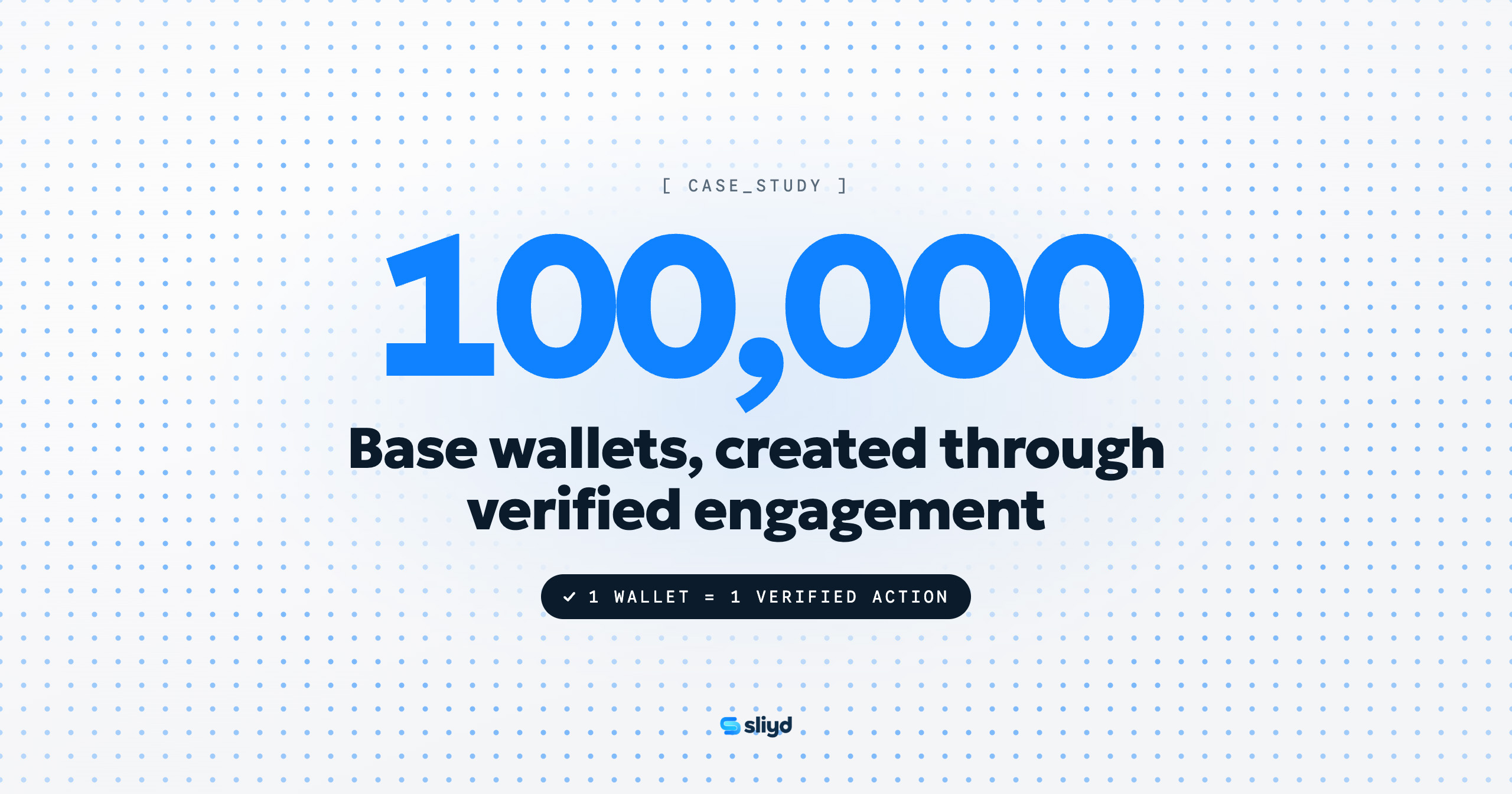
Sliyd’s 100k Drop combined one-click wallet creation, a short product video, a comprehension question and an instant TOSHI reward in a single link. The campaign produced more than 100,000 verified completions and over 100,000 new wallets on Base, with wallet creation in under five seconds and attribution at wallet level. The January announcement recorded the result. This is the detailed account of how it worked.
What was the challenge?
Digital-asset campaigns usually pull in two directions. They need scale, and they need quality. Remove every point of friction and participation rises, and so does the number of low-intent users passing through the campaign without engaging. Add qualification and the engagement signals improve, and every extra form, account and installation step creates another place for people to leave.
The 100k Drop needed both. The brief was to put a reward in front of a large audience, including people who had never used a wallet, and to make sure the people who received it had done something to receive it.
How did the campaign work?
The design kept the journey short and put the wallet inside it.
Open link → Watch → Answer → Verified → Wallet Created → TOSHI delivered → Wallet-level attribution
| Stage | What the participant did | What it proved |
|---|---|---|
| 1. Open the link | Entered from wherever the campaign had been distributed, with no app to install first | Reach beyond existing wallet holders |
| 2. Watch | Viewed a short product video | Exposure to the message |
| 3. Answer | Answered a question drawn from the video and needed a correct answer to progress | Comprehension |
| 4. Wallet created | Sliyd created a wallet in the same tap, in under five seconds | Onboarding without a separate technical task |
| 5. Receive | Sliyd delivered the TOSHI reward into the participant’s Sliyd wallet on verification | Reward tied to a completed, verified action |
Onboarding, education, verification and distribution happened in one flow. The campaign never asked anyone to leave it, set something up and find their way back.
Sliyd platform data
Campaign: Toshi
Network: Base
New wallets: 100,000+
Rewards distributed: 100,000+
Mechanism: Watch, Learn & Earn
Entry: single URL
Qualification: content comprehension
Reward: TOSHI
Attribution: wallet level
Wallet creation: under five seconds
Audience: Web2 and Web3 participants
What were the results?
According to Sliyd platform data, the campaign produced more than 100,000 rewards distributed, 100,000 new wallets on Base, wallet creation in under five seconds, wallet-level attribution across the funnel, and participation from both Web2 and Web3 audiences.
The wallet figure is the headline, and the attribution figure is the one that made the campaign reportable. Because each completion was tied to a wallet created in the same session, the campaign could show participation by person and by stage rather than a single total.
What did the funnel show?
A five-stage journey produces five numbers, and the gaps between them are where the campaign design gets tested. Drop-off between opening the link and the wallet appearing measures onboarding friction. Drop-off between the video and the question measures whether the content held attention. The gap between attempts and correct answers measures whether the message landed. Sliyd records each of those stages for every campaign, which is what lets a team change one screen and see the effect in the next report.
During the campaign, we also tested a small amount of reward claims that required no video. As expected, this resulted in a significant boost in completion with a commensurate drop in user engagement with the Sliyd application post-reward. Although this seems negative, it actually proved the thesis: Deeper engagement during the campaign resulted in a marked increase in post-reward engagement and retention.
Why did the learning step matter?
The campaign could have ended at the click. Instead, the campaign asked participants to show they had taken in the message before releasing the reward, which gives the brand a distinction it couldn’t otherwise make: reward claimed, versus reward received after a defined engagement.
It’s a small change to the customer journey and a large change to what the campaign can measure. A claim tells you someone wanted the reward. A correct answer tells you they watched the content and understood at least the point the question tested. The Watch, Learn & Earn format is built around that difference, and the 100k Drop ran it at scale.
Why did the wallet matter?
The second decision was to remove the traditional wallet onboarding sequence altogether. The campaign never asked mainstream participants to solve a technical problem before they could receive the reward. Sliyd created the wallet inside the reward flow, in the same tap that opened the campaign.
That decision is what let the campaign reach a Web2 audience. A campaign that requires an existing wallet can only reach existing wallet holders, and the audience most projects on Base want to reach is the one that doesn’t have a wallet yet. One-click wallet onboarding is the mechanism; the 100k Drop is the evidence that it works at six figures.
It is also important to note that although this campaign required the creation of a new wallet, Sliyd also offers users the option to claim a reward to their existing wallet. This puts the power in the hands of users, who aren’t required to use Sliyd in order to claim these rewards.
What can marketers take from the 100k Drop?
The principles transfer beyond this campaign and beyond Base.
Reduce friction that adds nothing to the objective. If a step exists for technical reasons rather than marketing ones, remove it from the participant’s view. The wallet still gets created; the participant doesn’t have to think about it.
Verify the action that matters. If learning matters, measure learning. If product use matters, measure product use. The verification step should test the behaviour the campaign was built to produce and nothing else.
Deliver the reward while the interaction is still happening. The shorter the gap between a verified completion and the reward, the clearer the exchange feels, and the more likely the participant is to remember who gave it to them.
Keep attribution at the level of the person. A wallet created in the same session as the action gives every completion an identifier, which is what turns a distribution into a dataset.
The 100k Drop was more than a distribution exercise. It demonstrated a model for combining reach, onboarding, education and reward in one measurable journey, and it did so with an audience that included people for whom this was their first wallet. The same design applies to a smaller campaign with a different reward, and it’s the model Sliyd recommends for any engaged airdrop on Base.
Want to run your own? Talk to Sliyd about a verified onboarding campaign on Base.