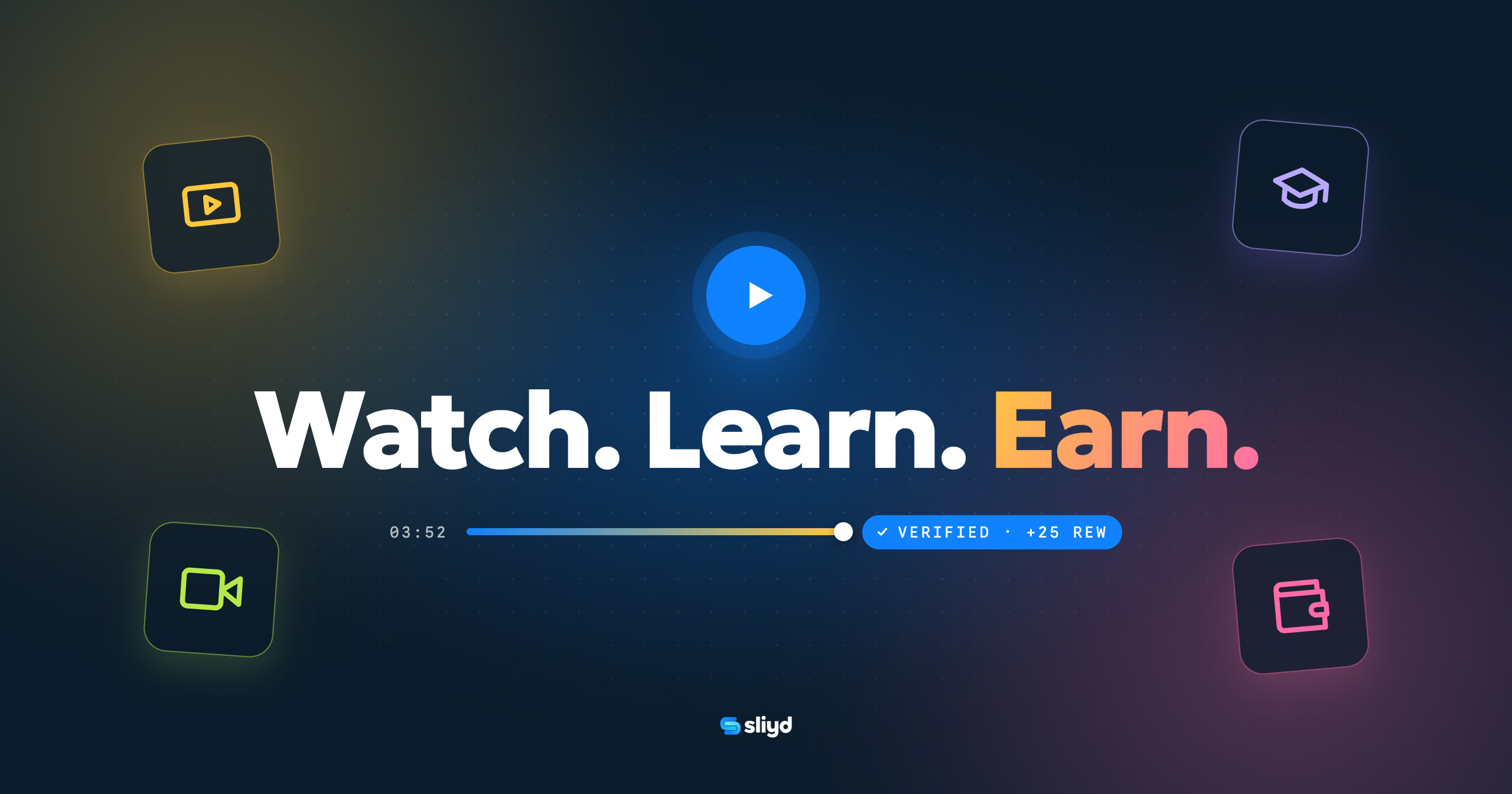
Sliyd’s Watch, Learn & Earn is a rewarded education format for brands and Web3 projects. A person watches a piece of content, answers questions about the content they have viewed, and receives a digital reward based on their correct answers. At its core, the concept is relatively simple, however, the results can be powerful. With Watch, Learn & Earn, the campaign metric moves from “video played” to “message understood”, and the budget pays for the second one.
Video is the format brands reach for when a product needs explaining, and it’s also the format where the measurement runs out soonest. This article covers how the format works, when to use it, what to measure and whether it holds up at scale.
How can a brand know whether somebody paid attention to an advert?
Ask them a question about it. Video advertising produces a full set of metrics: starts, watch time, completion, and clicks afterwards. Each one measures exposure. None of them tells you whether the viewer took in the message, and for a product launch, a feature explainer or an unfamiliar idea, that is the question the campaign was built to answer.
A comprehension question changes what the campaign can prove. A correct answer shows that the viewer took in at least the point the question tested. Attach the reward to the correct answer, and you’ve paid for understanding rather than for screen time.
How does Watch, Learn & Earn work?
Watch → Learn → Prove → EarnThe format adds one stage to a normal video view. After the content, the participant answers one or more questions drawn from it, and the campaign releases the reward on a correct answer.
Picture a launch video that explains three features of a new product. The question that follows asks which of those features lets the customer do a specific thing. A correct answer demonstrates basic comprehension, and the reward lands in the participant’s digital wallet in the same session. Sliyd’s Learn and Earn with Sliyd product update shows the flow on a phone.
The question should be fair. Ask about something the content stated in plain terms, keep the content short, and keep the reward proportional to the time asked. A five-minute video with a trick question at the end punishes the audience you were trying to teach.
When does rewarded education work best?
The format earns its keep when understanding matters more than blind reach.
| Situation | What you teach | What the question tests | Metric that matters |
|---|---|---|---|
| Product launch | What the product does | The core use case | Quiz pass rate, post-learning conversion |
| New feature | How the feature works | Where to find it or what it does | Pass rate among existing customers |
| Complex product | The one thing to understand first | That one thing | Cost per qualified view |
| Onboarding | How to complete the first important action | The first step | Activation after the reward |
| Partner campaign | Why two brands are working together | The partnership benefit | Pass rate, visits to the partner |
A launch is the clearest case. You’re paying to move people from “never heard of it” to “know what it’s for”, and a passed question is the closest thing to evidence that the move happened.
Incentivise deeper understanding with long form content
Long-form content is the other strong case for Watch, Learn & Earn, and it’s the one that most brands often don’t consider. A twelve-minute product walkthrough, a proper explainer on how something works, a piece that actually teaches: this is the content a conventional video buy can’t justify, because you pay the same for the viewer who leaves at ten seconds as for the one who stays to the end. Watch, Learn & Earn turns that around. The reward is only released to people who watched the whole piece and answered questions on its substance, so the skimmers cost nothing and the budget goes entirely to the audience that invested their time and attention. Keep the reward proportional to the length, ask questions that can’t be answered from the opening thirty seconds, and long-form stops being a risk and becomes the format’s most valuable use.
What should marketers measure?
Watch, Learn & Earn produces several layers of measurement, and they read in order down the funnel:
- Video start rate: how many people began.
- Video completion rate: how many reached the end.
- Quiz participation rate: how many attempted the questions.
- Quiz pass rate: how many demonstrated understanding.
- Cost per qualified view: what each completed learning journey cost.
- Post-learning conversion: what people did afterwards.
Sliyd’s product material describes the format as the move from “video played” to proven engagement, with full-view completion, quiz pass rate and cost per qualified view as the reporting set. Cost per qualified view is the education-specific form of cost per verified action, and it slots into a media plan the same way.
The gap between completion rate and pass rate is the number to watch. A wide gap means people are reaching the question and getting it wrong, which is a content problem: the video didn’t land the point, or the question tested something else.
Does it work at scale?
Sliyd platform data, 100k Drop (January 2026). Participants entered through a single link, watched a short video, answered a question drawn from it and received their reward on a correct answer. The campaign produced more than 100,000 verified completions and 100,000 new digital wallets.
The 100k Drop settled the question of whether a comprehension step makes a funnel unusable. It doesn’t, provided the learning is short, relevant and proportional to the reward.
The format also answers a criticism that follows rewarded content around: that people will sit through anything for a reward. They will, and a comprehension question means sitting through it is no longer enough.
Reward understanding rather than screen time
A good educational campaign doesn’t ask for five minutes of attention because the advertiser wants five minutes of attention. Give people useful information, ask a fair question about it, and reward them when they show they understood. Both sides get something from that exchange, and the report at the end shows a pass rate rather than a view count.
Want your next explainer to prove it landed? Talk to Sliyd about building a Watch, Learn & Earn journey into your rewarded action marketing.
FAQs
Watch, Learn & Earn is a rewarded education format where a participant watches content, answers questions drawn from it and receives a digital reward on a correct answer. The reward is tied to demonstrated understanding rather than to a completed view.
Short enough that the reward feels proportional to the time asked, and focused on the one or two points the question will test. Long content with a difficult question raises drop-off and lowers pass rates without teaching more.
Campaign spend divided by the number of participants who completed the content and passed the question. It is the education-specific version of cost per verified action.
It adds a stage, so some drop-off is expected, and a stage-by-stage report shows how much. Sliyd’s 100k Drop ran the format at the scale of 100,000 verified completions, which shows the step can be kept short enough that the funnel holds.