Published 24 February 2026 · Last updated September 2026
Onboarding. The single pivot point where potential is fulfilled, or vanishes entirely. Every year, brilliant products built on breakthrough technology quietly fail simply because they treat the first user experience as an afterthought. Meanwhile, far more ordinary, even terrible, products and services have thrived by mastering the first step in engagement. Onboarding is an area where products live or die. When you get onboarding right, you don’t just engage users with your product; you prove to them why they can’t live without it.
Many promising web3 projects have failed due to complex onboarding, and this is the problem that Sliyd aims to solve. Sliyd’s One-click wallet onboarding distils the complex process of opening a digital wallet and receiving a digital reward into a single click. For consumers, it is the minimum possible barrier to onboarding. For web3 projects, it removes the most significant barrier, allowing users to experience value up front and become invested in your brand immediately.
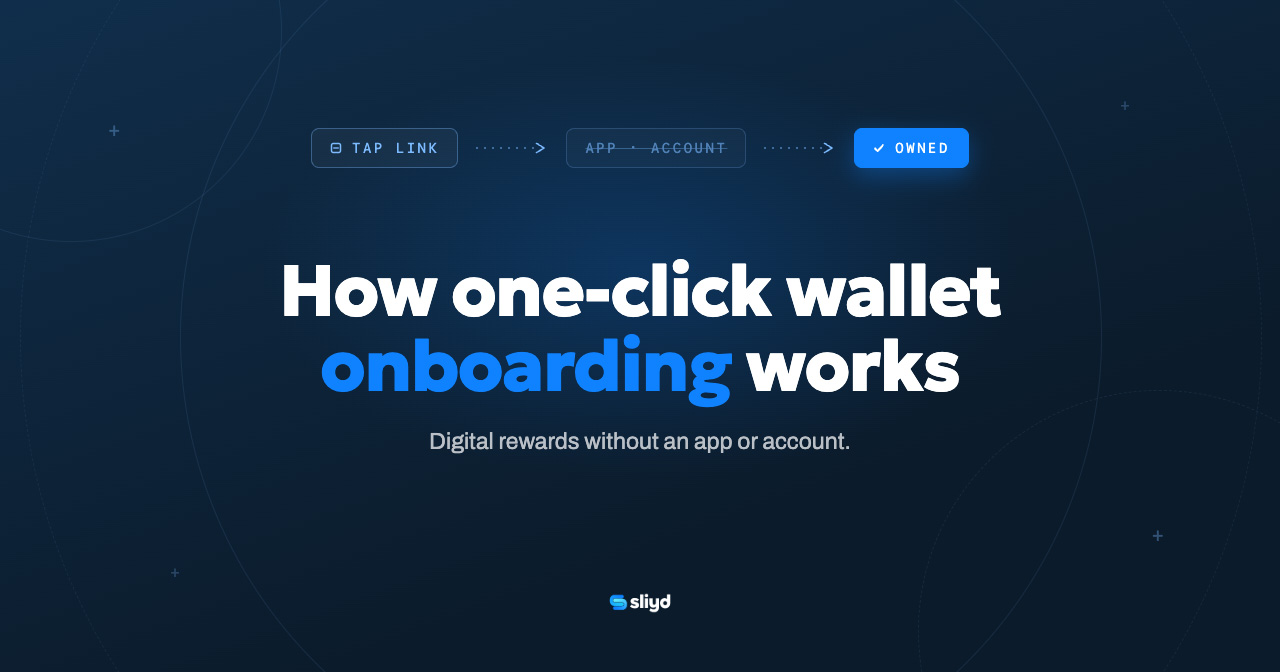
Sliyd works for anybody in a single click, perhaps most importantly, even when the target user doesn’t currently have a digital wallet. In practice, a person opens a campaign link, the campaign creates a wallet for them in the same tap, they complete the action, and the reward lands in that wallet. There’s no app to install, no account to set up and nothing to learn before the reward arrives. For the user, it reads as click, participate, receive.
Wallet creation has long been the step where Web3 campaigns lose the audience they were built to reach. This article discusses why that happens, what a one-click Sliyd wallet is, and when a brand should use it.
Why does wallet creation cause Web3 campaign drop-off?
Every extra step gives someone a reason to leave, and a conventional wallet setup has more steps than most sign-up flows. Picture an advert that promises a digital reward, followed by a request to download an application, choose a username, set a password, learn what a wallet is, write down a recovery phrase and then find your way back to the original campaign.
While an experienced Web3 user treats some of those steps as routine, everyone else weighs the work against the reward and closes the tab. If 100 people click a campaign and 50% of people leave during wallet setup, then wallet setup is part of your acquisition funnel, whether or not it shows in your media dashboard. In fact, research by AP Collective, a prominent crypto and blockchain marketing agency, found that 99% of users drop off or abandon their wallets during the initial setup phase, often when asked to secure or write down a seed phrase before they have even interacted with the app.
That reframes the problem. Wallet onboarding is a conversion problem for marketers before it’s a technical one, and it affects user acquisition, campaign conversion, cost per participant, and the number of steps your team has to explain.
What is a one-click wallet?
A one-click wallet is a wallet that opens from a link, with no separate application required. The wallet experience becomes part of the campaign rather than a prerequisite for it.
Sliyd was built around that idea. A recipient opens a Sliyd link and gets the wallet experience without installing anything first, and the reward can be delivered in seconds. Sliyd’s own demo describes it in one line:
“Scan. Follow. Answer one question. Reward in ten seconds. No app. No account.”
The wider industry has been moving the same way. Base’s smart wallet work and the account abstraction roadmap on ethereum.org both aim to remove setup steps from the first interaction. Sliyd’s approach delivers the wallet through the link itself, which suits campaigns because the campaign link is already the thing you’re distributing.
Can users receive digital rewards without installing an app?
Yes. That was the premise of the Sliyd Beta: the one-click digital wallet, and it’s the reason the wallet is delivered by link rather than by app store. The recipient opens the link on the phone they already have, the campaign creates the wallet in the background, and the reward is waiting when the action is complete.
For a marketer, the important consequence is reach. A campaign that requires an app download can only convert the people willing to install one. A campaign that works from a link can convert anyone who can open a web page, which includes the mainstream audience that most brand campaigns are aimed at.
How does link-based wallet onboarding work?
Open link → Wallet created → Complete action → Action verified → Reward delivered → Attribution at wallet level| Stage | Traditional wallet onboarding | One-click wallet onboarding |
|---|---|---|
| Entry | Download an app from a store | Open a link or scan a QR code |
| Account | Username, password, recovery phrase | Created in the same tap |
| Return to campaign | Find the original link again | Already there |
| Action | Completed after setup, if the user comes back | Completed in the same session |
| Reward | Delivered after a claim step | Delivered on verification |
| Attribution | Depends on the user linking accounts | Tied to the wallet from the first tap |
The campaign creates the wallet in the same session as the action, so verification and attribution attach to it from the start. Each verified action carries the wallet identifier, which is what lets a campaign report participation by person rather than by click.
When should brands use invisible wallet infrastructure?
Use it when the campaign is the point and the wallet is plumbing. The case is strongest in these situations:
- A mainstream audience. Most of your customers don’t own a wallet and won’t install one for a promotion.
- A reward that is small relative to the effort. The exchange has to feel fair, and six setup steps for a small reward doesn’t.
- A journey that needs the user to stay in flow. Watch, answer, receive works when it happens in one sitting.
- A result you need to attribute. A wallet created in the same tap gives every completion an identifier.
Sliyd platform data, 100k Drop (January 2026). The campaign used one link, a short piece of educational content and one question before delivering the reward. It created 100,000 new wallets on Base, with wallet creation in under five seconds, and participants completed the experience without downloading an application. The audience included people with no prior Web3 experience.
The lesson from the 100k Drop goes beyond the wallet count. Wallet creation never appeared as a separate technical task. It became part of the user journey, and the participants treated it that way. The detailed case study covers the funnel step by step.
Few consumers want to understand the architecture behind a marketing campaign. They want to know what they’re being asked to do, what they’ll receive and how long it will take. Wallet technology is most useful when it answers those three questions without becoming a fourth. For digital rewards, the best wallet experience is the one the user doesn’t have to think about.
See how one-click digital rewards fit your customer journey. Talk to Sliyd about rewarded action marketing without the setup.
FAQs
One-click wallet onboarding creates a wallet for the user at the moment they open a campaign link, so they can complete an action and receive a reward without installing an app or setting up an account first.
No. With a link-based wallet, the recipient opens the link, the campaign creates a wallet for them, and the reward lands in it once the action is verified.
In Sliyd’s 100k Drop, wallet creation took under five seconds, inside the same session as the campaign action.
Yes. The 100k Drop was completed by participants without any prior Web3 experience, because the journey asked them to open a link, watch, answer and receive rather than to set anything up.