Published 3 February 2026 · Last updated September 2026
For a lot of marketers every campaign ends the same way: a wrap-up deck, a big number on the first slide, and a room quietly wondering whether it meant anything. Rewards issued, entries received, impressions served – those numbers describe what the campaign did. The people who funded the campaign want to know what the audience did, and whether it was worth the money.
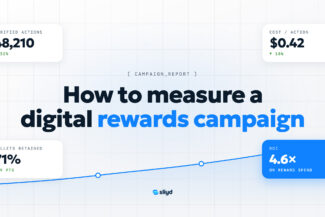
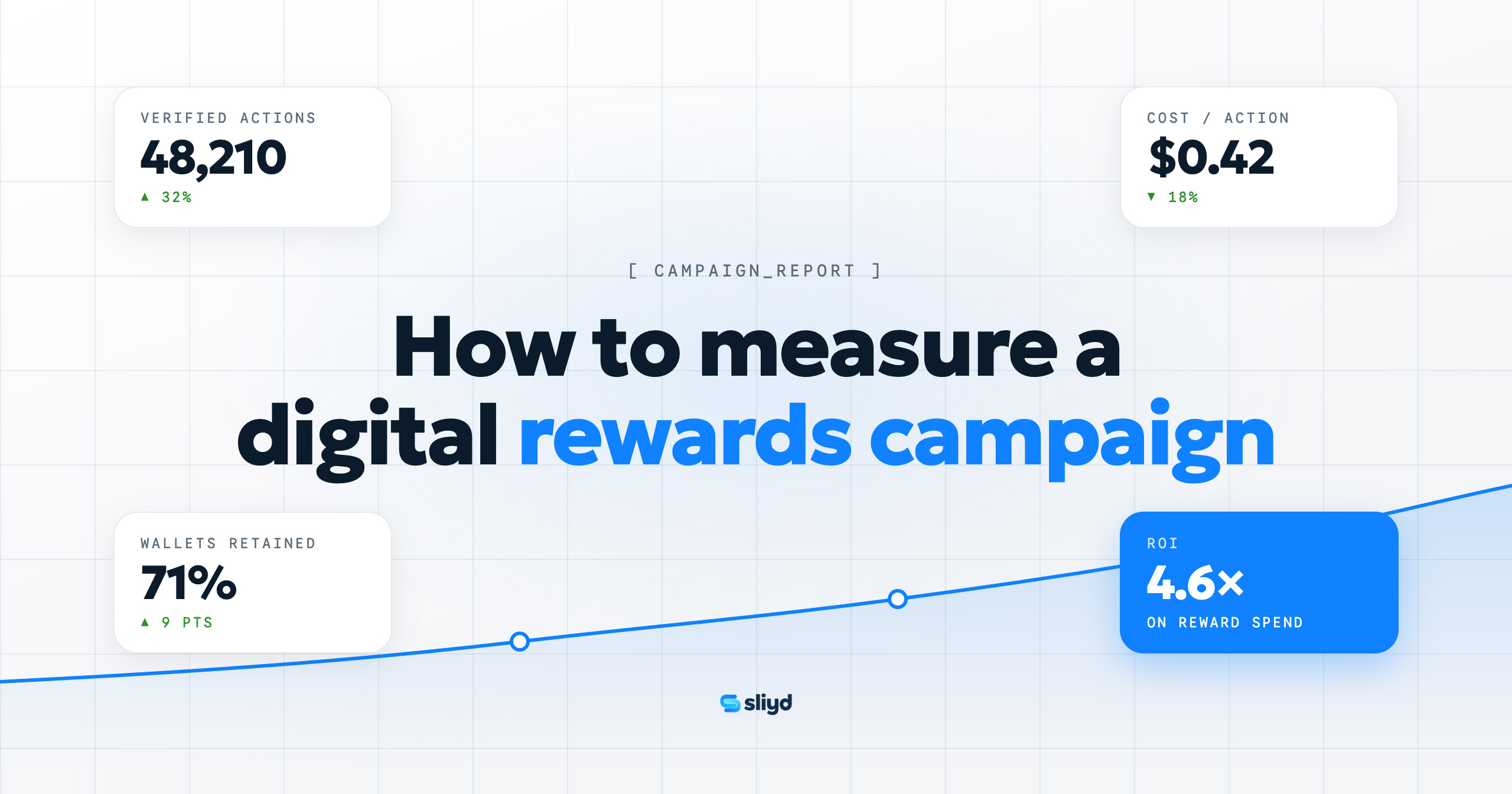
Measuring campaign results properly means comparing what the campaign did against the behaviour the campaign was designed to achieve. The metrics that do that are no. of verified cost per verified action, completion rate, verification rate, conversion after the reward, and funnel drop-off. The reward is the incentive; the verified action is the result you paid for.
Below, we take them in the order a finance director might ask about them.
What is Sliyd’s cost per verified action?
Cost per verified action (CPVA) is the campaign spend divided by the number of actions that passed verification.
Campaign spend ÷ verified actions = cost per verified actionAs an illustration, a £5,000 campaign that produces 10,000 verified actions has a CPVA of £0.50.
CPVA differs from cost per click in what it counts. A click tells you someone touched a link. A verified action tells you they completed the behaviour the campaign was built around: passing a quiz, completing a referral, finishing a product step, answering a poll. The denominator is smaller and the number means more.
The metric earns its place because it sits alongside CPC, CPA and cost per lead in the same media plan. A rewarded campaign reported at £0.43 per verified action can be compared with any other channel on the plan, which is the comparison that decides whether the channel gets budget again.
Which metrics should you track?
| Metric | Question it answers | What a poor number tells you |
|---|---|---|
| Completion rate | Of the people who opened the campaign, how many reached the required action? | Friction somewhere in the journey |
| Verification rate | Of the actions submitted, how many passed verification? | Low-quality participation, a confusing brief, or abuse |
| Cost per verified action | What did each successful action cost? | The action is too demanding for the reward, or the audience is wrong |
| Funnel drop-off | At which stage did people stop? | Which screen to fix first |
| Post-engagement conversion | What did participants do after the reward? | The action is too far from the commercial objective |
| Repeat participation | Did people come back for a second campaign? | The exchange felt one-sided |
Completion rate and verification rate are the pair to watch together. High completion with low verification means people are reaching the end of the journey and failing the check, which points to a brief that promises more than the action delivers, or to people attempting the action without doing it. Low completion with high verification means the journey is losing people before the action, and the ones who stay are real.
Where do people drop out of a rewards campaign?
A multi-step campaign needs a number at every stage, because a single completion rate hides where the problem is.
Open campaign → Watch video → Complete quiz → Pass verification → Receive rewardKnowing that 10,000 people started is useful. Knowing that 42% of the people who left did so on the quiz screen tells you what to change. That figure is an illustration, and it’s the kind of figure a stage-by-stage report produces. Sliyd’s campaign structure can chain several actions into one reward journey and record the drop-off between each stage. With Sliyd the report shows you the funnel giving you a bigger picture of how deeply your audience absorbed your message
The same view answers the question every campaign designer faces: how much can you ask of someone before the reward stops being worth it? Put the answer in the drop-off numbers rather than in a debate.
What makes a good rewards campaign report?
Keep it to the questions a stakeholder asks: what was spent, what people did, how many of those actions were verified, what each verified action cost, and what happened afterwards.
How Sliyd reports a campaign. Sliyd campaigns run on verified activity. Budget draws down as actions pass verification, not when someone attempts them. Reporting separates verified from rejected actions, shows participation in real time and treats cost per verified action as the primary metric.
Answer the five questions first and put every secondary metric below them. “We gave out 20,000 rewards” is a giveaway statistic. “We generated 14,200 verified actions at £0.43 each, 21% of participants completed a second action and 8% converted to the next stage” is a marketing result, and it’s the format that survives a budget review. (Illustrative figures.)
Campaign-specific metrics slot in underneath: quiz pass rate for Watch, Learn & Earn, qualified referrals for a referral campaign, stage drop-off for a multi-step journey. The wider argument for verified actions as a measurement model applies to every one of them.
Digital rewards become easy to justify when they’re reported the way the rest of the media plan is reported. Start with cost per verified action, keep the funnel visible, and follow participants past the reward.
Want a report that reads like a marketing result? Talk to Sliyd about running a verified rewarded action marketing campaign.
FAQs
Divide the total campaign spend by the number of actions that passed verification. A £5,000 campaign producing 10,000 verified actions has a cost per verified action of £0.50.
Cost per click counts every interaction with a link. Cost per verified action counts only the completed behaviours that passed a check, such as a correct quiz answer or a completed referral. The second number is smaller and describes an outcome rather than an interaction.
Cost per verified action, completion rate, verification rate, funnel drop-off by stage, conversion after the reward and repeat participation. Report them in that order.
Attach an identifier to each verified action, then match it against later events: product visits, account creation, purchases, return visits or participation in another campaign. In a Sliyd campaign the identifier is the participant’s digital wallet.