Published 23 April 2026 · Last updated September 2026
What puts the “engage” in an engaged airdrop? Let’s find out.
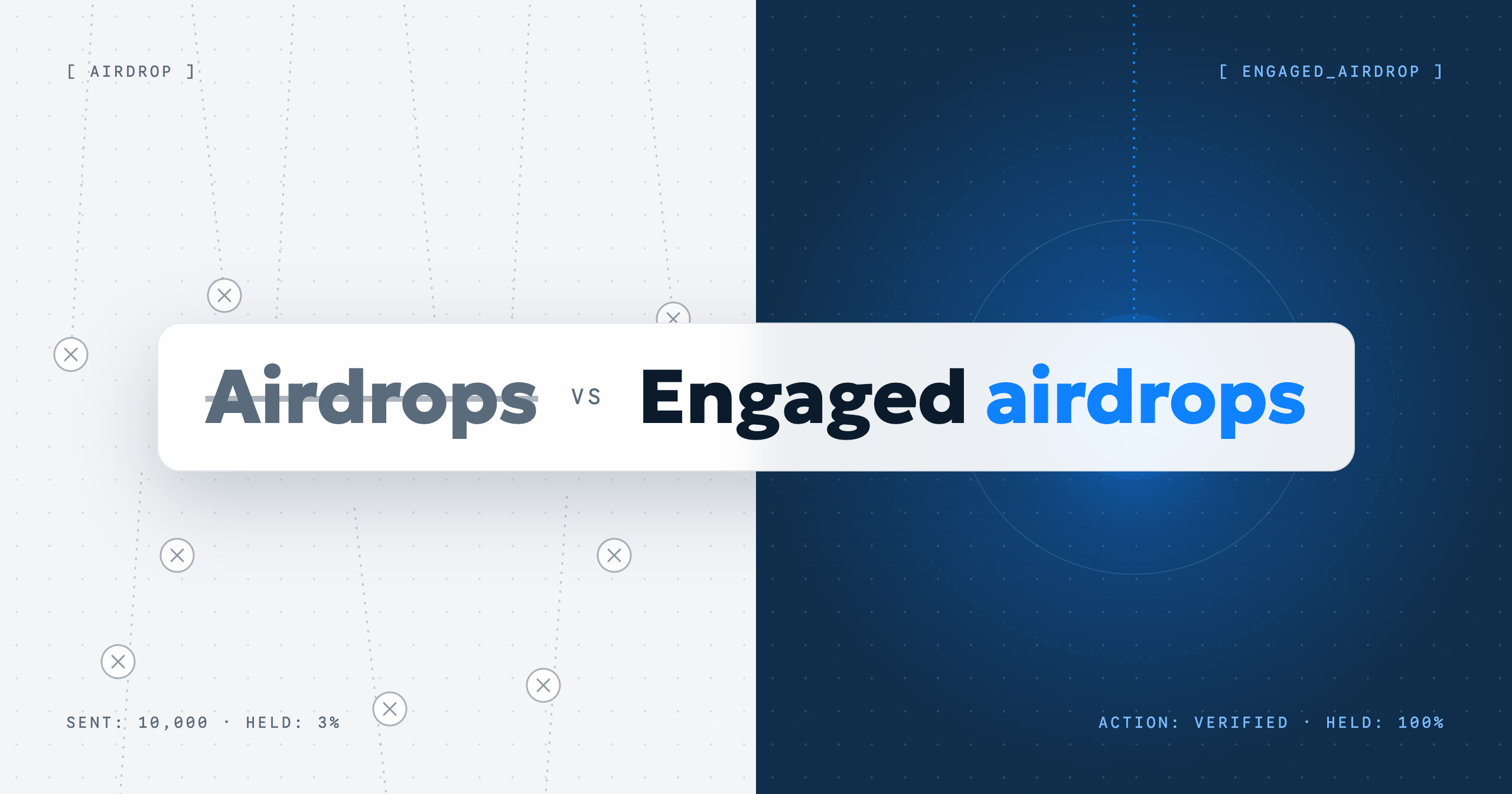
A traditional airdrop distributes assets to wallets, sometimes these wallets meet loose criteria, while others follow a scattergun approach that leaves the airdropper hoping for success. An engaged airdrop is very different, it adds a behavioural step first: the participant learns about a project, completes an action or answers a question based on what they learned, the action is verified, and the asset follows. The two models serve different purposes: one reaches wallets, and the other creates qualified participants. Only the users willing to make an effort and learn about your project get a reward – with the “airdropper” setting a reward relative to the amount of effort required.
Airdrops remain one of the most effective distribution tools in Web3, and the criticism they attract is aimed, for the most part, at what happens after the drop. This article sets out both models, the trade-offs between them, and when each one is the right choice.
What is a traditional airdrop?
At its simplest, a traditional airdrop works as follows: wallet qualifies → asset is distributed. Qualification might be holding a particular asset, having used a protocol before a snapshot date, or appearing on an allowlist. The model’s strength is its simplicity: it works at almost any scale, which makes it effective when distribution itself is the objective.
Its weakness is what it can’t tell you. Receiving an asset proves nothing about whether the recipient understands the project, has tried the product or intends to come back. A wallet count is a wallet count.
What is an engaged airdrop?
An engaged airdrop inserts a meaningful action before distribution.
Open campaign → Watch product explanation → Answer question → Pass verification → Receive reward → Post participation Re-engagementOther campaigns swap the middle step for a product action, a referral, an event check-in or another verifiable behaviour. The reward still supplies the incentive. Qualification becomes part of the growth strategy instead of a snapshot taken before it.
Sliyd defines the format as opt-in, then guided engagement, then a proof step, then the reward. The proof step is what makes the airdrop engaged rather than gated: the participant demonstrates something, and the campaign records it.
Another key aspect is the opportunity for direct re-engagement, with an airdropper having the ability to add secondary campaigns that are exclusively available to users who engaged with the first campaign – creating deeper user engagement and product understanding.
Why add engagement before distribution?
Wallets aren’t users. If the objective is education, onboarding or customer acquisition, transferring an asset to an address tells you almost nothing about the person behind it. An engaged journey produces signals a traditional drop can’t: content completion, comprehension, successful onboarding, referral activity, product interaction and campaign attribution, all with the user having control over their sovereign data.
Those signals change what you can do next. A project that knows which recipients passed a product question can re-engage them in a different way from the ones who didn’t, and can report participation rather than distribution.
What is the difference between an airdrop and an engaged airdrop?
| Dimension | Traditional airdrop | Engaged airdrop |
|---|---|---|
| Qualification | Snapshot, holding or allowlist | A completed, verified action |
| Comprehension | Unknown | Tested by a question drawn from the content |
| User intent | Inferred from wallet history | Demonstrated in the journey |
| Farming exposure | High: the criteria are public & static | Lower: each stage is harder to automate than the last |
| Wallet creation | Requires an existing wallet | Can create the wallet inside the link |
| Attribution | Address level | Wallet level, per stage |
| Retention signal | None until the recipient acts later | Built into the journey |
| Re-engagement | Blanket | Segmented by what each participant did |
The rows on farming and wallet creation are where the models diverge most. A static snapshot can be gamed in advance. A journey with one-click wallet onboarding inside it can reach people who had no wallet at all, which is the audience most projects say they want and most airdrops never touch.
What about airdrop farmers?
Any open reward creates an incentive to optimise around the rules, and assuming every participant has high intent is a mistake. The practical response is to design qualification around behaviours that get harder to fake or automate at each stage, and a multi-step journey is one way to do that.
How Sliyd handles it. Sliyd’s campaign architecture chains several actions into one reward journey and records drop-off at each stage, so a team can build a more demanding qualification path where the campaign warrants it and see where low-intent traffic falls away. Defences are in place to detect suspicious behaviour across a campaign.
Drop-off data is the underrated part. A farmer who abandons at the comprehension question has told you something useful, and so has the participant who completed every stage.
What did Sliyd do with the 100k Drop?
The 100k Drop combined asset distribution with product education. Participants entered through a single link, watched a short piece of content, answered a question drawn from it and received their reward on a correct answer. The campaign created 100,000 new wallets on Base, with the reward tied to participation rather than to an address appearing on a list.
Which model should you use?
Use a traditional airdrop when broad distribution is the goal and you’re content to learn about the recipients later.
Use an engaged airdrop when you also need people to understand something, perform an action, enter a product, demonstrate intent or become measurable participants. The extra step costs you some completion, and the drop-off numbers will tell you how much; in return you get a distribution that doubles as onboarding.
Neither mechanism is better in the abstract. They solve different problems, and the useful question is which problem you have. As distribution moves from wallets to participants, the same verified-action model extends to agents as well as people; the agentic payments on Base article covers that next step.
Planning a distribution on Base? Talk to Sliyd about running it as an engaged airdrop.
FAQs
An engaged airdrop adds a verified action before distribution: the participant learns something, completes an action or answers a question, the campaign checks the action and then distributes the asset. Sliyd defines it as opt-in, guided engagement, a proof step, then the reward.
A traditional airdrop distributes to wallets that meet static criteria such as a snapshot or an allowlist. An engaged airdrop distributes to participants who have completed a verified behaviour, so it produces comprehension, intent and attribution signals as well as a wallet count.
It raises the cost of farming, because each verified stage is harder to automate than a static qualification, and per-stage drop-off shows where low-intent traffic leaves. It does not remove the incentive to game a reward, so suspicious-behaviour detection still matters.
Yes. With one-click wallet onboarding the campaign creates the wallet inside the link, so the journey can reach a mainstream audience as well as existing wallet holders.